

The Darksaber: Complete History of Mandalore's Most Iconic Weapon (2026)

"The Darksaber is part of Mandalorian culture. It's part of their heritage — and that's what makes it worth fighting for."
Dave Filoni said it best. No weapon in all of SW carries as much history, contested legitimacy, and raw emotional weight as the Darksaber. It is not merely a saber — it is Mando itself, held in your hands. A flat black blade with crackling white-silver edges that has passed from warlord to warlord across a thousand years of civilization, wars, and a single catastrophic betrayal.
With The Mandalorian & Grogu released in theaters on May 22, 2026, and the Darksaber having met its end in Season 3, the film has now confirmed that the black blade does not return. This article traces every chapter of the weapon’s extraordinary story — from the first Mandalorian Jedi who forged it, to its final destruction and the surprising resolution that Mandalorians no longer need it to unite.
- Quick Answers
- Origin — Tarre Vizsla
- Jedi Temple & Family Reclamation
- CW — Pre Vizsla & Maul
- Rebels — Sabine Wren's Arc
- The Great Purge — Bo-Katan's Surrender
- The Mandalorian — Din Djarin
- Season 3 — The Darksaber Dies
- Can the Darksaber Be Repaired? (2026 Movie Answer)
- Complete Timeline — All Owners
- Why the Darksaber Matters
- Own the Darksaber — CCSabers
- FAQ
1. Quick Answers
The Darksaber was forged by Tarre Vizsla, the first Mandalorian ever inducted into the Jedi Order. Unlike any standard saber, he created a flat, black-bladed weapon with a curved Beskar hilt — a fusion of Jedi craftsmanship and Mandalorian sword tradition.
In canonical order: Tarre Vizsla (creator) → Jedi Order (custodians) → Vizsla family → Pre Vizsla → Darth Maul → Darth Sidious (briefly) → Maul (recovered) → Sabine Wren → Bo-Katan Kryze (first) → Moff Gideon → Din Djarin → Bo-Katan Kryze (second) → Destroyed in Season 3 finale.
The Darksaber was destroyed in the Season 3 finale. Bo-Katan Kryze wielded it in the final battle against Moff Gideon on Mando. The hilt shattered and the black blade went permanently dark — the first confirmed, irreversible destruction of the Darksaber in SW canon.
The Darksaber has a flat, black plasma blade shaped like a traditional sword — unlike the cylindrical blades of all standard sabers. Its crackling white-silver energy corona is unique. It also responds to its wielder's emotional state: it becomes heavier when the wielder is internally conflicted — a property no other saber in SW canon shares.
No – the Darksaber was not repaired and does not appear in The Mandalorian & Grogu (May 22, 2026). The film confirms that Mandalorian leadership no longer depends on the blade. The weapon remains destroyed in current canon.
2. The Birth of a Legend — Tarre Vizsla

The First Mandalorian Jedi
Over one thousand years before TPM, a Mandalorian named Tarre Vizsla was inducted into the Jedi Order. This was, by any measure, extraordinary. Mandalorians and Jedi had fought devastating wars across centuries — their civilizations were ancient enemies. A Mandalorian becoming a Jedi wasn't merely rare. To many, it was an act of cultural heresy.
Vizsla didn't simply adapt to Jedi tradition. He fused it with his own. Rather than building the standard cylindrical saber, he designed something entirely different: a flat, black plasma blade shaped like a Mandalorian sword — a curved Beskar hilt, crackling white-silver energy corona surrounding a dark core. It was Jedi craftsmanship married to Mandalorian aesthetics, and it was unlike anything the galaxy had ever seen before or since.
Mand'alor and Jedi
Tarre Vizsla eventually became Mand'alor — the supreme ruler of all Mandalorian clans — while maintaining his status as a Jedi. The Darksaber became the symbol of that dual identity: the blade of a warrior, the construction of a scholar, the authority of a ruler, all forged into a single weapon. The only object in the galaxy that embodied both Jedi power and Mandalorian leadership simultaneously.
Dave Filoni introduced the Darksaber in CW episode The Mando Plot (2010). His direction was clear: "It had to feel ancient. It had to feel like something that has a history to it." The flat black blade was deliberately chosen to visually contrast with every other saber ever shown — a weapon that looks like it remembers the battles it survived.
2025 Theory: Alliance Against the Sith
A 2025 analysis proposed a compelling new layer: Tarre Vizsla's era coincided with intensifying Sith aggression across the Republic. The theory suggests the Jedi may have lowered traditional barriers to Mandalorian recruitment because they needed warriors. If true, the Darksaber was forged in the context of the galaxy's most desperate alliance — which gives its later role as a symbol of Mandalorian independence an even deeper historical irony.
3. The Jedi Temple & Family Reclamation

Preserved in Coruscant
After Tarre Vizsla's death, the Jedi Order preserved the Darksaber at the Jedi Temple on Coruscant as a historical artifact. For the Jedi, it was a relic of a remarkable and singular figure. For Mandalorians, it was something else: the birthright of the Vizsla bloodline, held captive on a distant planet by people who had no claim to Mandalorian culture.
The "Liberation"
When the Old Republic fell into crisis, members of the Vizsla family infiltrated the Jedi Temple and reclaimed the Darksaber. In Mandalorian history, this is told not as a theft but as a liberation — the restoration of a stolen symbol. The distinction matters enormously: in Mandalorian culture, how you obtain a weapon defines your right to wield it.
4. CW — The Blade Changes Hands

Pre Vizsla and Death Watch
By the CW, the Darksaber had passed to Pre Vizsla, leader of Death Watch — the Mandalorian splinter faction that rejected Duchess Satine Kryze's pacifist government. Pre Vizsla was among the most skilled Darksaber users in its history, trained extensively in the flat-blade techniques the weapon's unique geometry demands. He displayed it constantly as proof of lineage and legitimacy.
Darth Maul's Conquest
Pre Vizsla made a fatal strategic error: he allied with Darth Maul to overthrow Satine, then tried to betray him. Maul challenged him to single combat — a challenge Pre Vizsla couldn't decline without forfeiting his claim to Mandalorian leadership — and won. In front of his own warriors, Pre Vizsla was defeated and killed. Darth Maul took the Darksaber and declared himself ruler of Death Watch. The Mandalorian warriors present accepted this, because the blade had changed hands in legitimate combat. For the first time in history, the Darksaber was held by a non-Mandalorian.
Maul's acquisition created a lasting crisis of legitimacy: can a non-Mandalorian hold the blade? The rule of combat says yes — and Mandalorian warriors respected the outcome. This precedent would echo to Moff Gideon's tenure decades later, when he held the Darksaber for years without a legitimate combat claim to his name.
Palpatine's Intervention
Darth Sidious traveled personally to Mando to deal with his former apprentice. After a brutal confrontation, Maul was defeated. Sidious briefly held the Darksaber — one of the most powerful men in the galaxy momentarily in possession of the symbol of Mandalorian authority. Maul eventually recovered the blade before retreating to Dathomir, where he would ultimately abandon it — leaving the Darksaber in the ruins of his power base, waiting for someone to reclaim it.
5. Rebels — Sabine Wren's Unlikely Arc

Discovery on Dathomir
In SW Rebels, Ezra Bridger discovered the Darksaber while exploring Maul's former stronghold on Dathomir and brought it to Sabine Wren, the Mandalorian crew member of the Ghost. Sabine recognized it immediately. What followed was one of the most emotionally complex arcs in Rebels: a Mandalorian who didn't want the responsibility of a symbol, forced to learn that some burdens cannot be refused.
Training and the Weight of History
Sabine initially resisted the blade's pull. She wasn't royalty, hadn't won it in combat, and — most crucially — didn't want to be Mand'alor. Kanan trained her through unconventional methods, teaching her to channel the Darksaber's resistance rather than fight it. The blade's weight responded to her emotional state. Her hesitation made it heavier. Her conviction would make it move like an extension of her will.
Defeating Gar Saxon — and the Fateful Gift
Sabine returned to her family and faced Imperial Governor Gar Saxon in single combat, defeating him and legitimately winning the Darksaber under Mandalorian tradition. Then she made the decision that would reshape Mandalorian history: she gifted it to Bo-Katan Kryze, believing the experienced warrior should lead. The gift was an act of selfless wisdom. It was also a breach of the one rule the Darksaber had always demanded. Bo-Katan accepted a blade she hadn't won, and the fractures began immediately.
The non-combat transfer from Sabine to Bo-Katan created the political crisis that directly contributed to the Great Purge. Some clans refused to follow a leader who hadn't won the blade in combat. This fractured Mandalorian unity precisely when the Empire was preparing its assault. One well-intentioned gift — handed across with genuine love for her people — became one of the most consequential mistakes in Mandalorian history.
6. The Great Purge — The Night of a Thousand Tears

Bo-Katan's First Reign
With the Darksaber, Bo-Katan briefly unified Mando. She had the symbol, the experience, and the political vision. But the Galactic Empire — and Moff Gideon in particular — had plans for both Mando and its most powerful icon.
Season 3, Chapter 7 — The Truth Revealed
For years, fans debated how Moff Gideon obtained the Darksaber. The answer, confirmed in Season 3 Episode 7, was more tragic than most anticipated. Bo-Katan, facing the overwhelming might of Imperial forces during the Great Purge, attempted to negotiate a surrender — not for herself, but to save Mandalorian lives. As the price of that surrender, she handed Gideon the Darksaber.
The Empire broke the deal immediately. Imperial forces carried out the orbital bombardment of Mando — the Night of a Thousand Tears — killing most of the planet's population and reducing its civilization to scattered survivors. Bo-Katan lost both her people and the Darksaber in the same night. The survivors blamed her personally, and not entirely without reason. The blade she'd received as a gift, rather than won in combat, had never fully protected her claim — and when the moment of crisis came, it wasn't enough.
Moff Gideon — The Most Illegitimate Holder
Moff Gideon never won the Darksaber in combat. He extorted it from a surrender he subsequently betrayed — making his claim the most illegitimate in the weapon's entire thousand-year history. He used it as a psychological weapon against Mandalorian survivors: proof that their culture's most sacred symbol had been captured by the same man who had helped destroy their world.
7. The Mandalorian — Din Djarin's Burden

Season 1 Finale — The Black Blade Returns
The Season 1 finale delivered the Darksaber's live-action debut: Moff Gideon cutting his way out of a crashed TIE fighter, the flat black blade crackling against darkness on Tatooine. For fans of CW and Rebels, it was a full-circle arrival of years of story — a weapon with a thousand years of history, held by the man who had helped end Mando's civilization.
Season 2 — Din Djarin Wins the Blade
In the Season 2 finale, Din Djarin defeated Moff Gideon in combat and took the Darksaber. By every Mandalorian tradition, his claim was fully legitimate. The problem: Din had no interest in ruling. He understood the weapon but not the cultural weight attached to it, and he tried to give it to Bo-Katan — the person he believed should lead. She refused. The Darksaber stayed with a man who didn't want it, couldn't fully wield it, and had no intention of leading anyone.
The Blade That Fought Back
When Din trained with the Darksaber in The Book of Boba Fett, the weapon resisted him. It dragged. It pulled. Paz Vizsla explained what Mandalorian tradition has always understood: the blade doesn't resist skill — it resists internal conflict. Din's reluctance to lead was written into every labored swing. The Darksaber was functioning exactly as intended: as a mirror of its wielder's relationship with power.
The Creative Resolution
The legitimacy problem was solved with elegant Mandalorian logic in Season 3. After Din Djarin's capture by Gideon, Bo-Katan fought and defeated those responsible. Din — as the recognized holder — effectively witnessed Bo-Katan defeat the chain of combat that led back to him. The community recognized this as a valid transfer. Bo-Katan took the Darksaber with enough legitimacy for her people to follow — a resolution that honored tradition without being strangled by it.
8. Season 3 Finale — The Darksaber Dies

The Final Battle
The Season 3 finale brought the Darksaber to its most consequential moment since Tarre Vizsla first ignited it. Bo-Katan Kryze, wielding it with more confidence than at any prior point in her arc, faced Moff Gideon in the ruins of Mando — the planet whose destruction he had ordered. Gideon had built himself new Beskar armor and an army of shadow commandos designed to counter Mandalorian resistance. In the chaos of the final engagement, the Darksaber was destroyed. The hilt shattered. The black blade went dark and silent for the first time in a thousand years.
The First Canonical Death
This was not a dramatic loss that could be reversed. The Darksaber had been captured, transferred, stolen, and hidden many times — but never broken. The Season 3 ending was unambiguous: the most iconic weapon in Mandalorian history was gone. For the first time, a story that had defined the Darksaber as an indestructible symbol of cultural continuity ended with the symbol destroyed.
What happened after the Darksaber's destruction is as significant as the destruction itself. Bo-Katan continued to lead. Mandalorian clans continued to follow her. The physical absence of the blade didn't collapse the leadership it had represented. Dave Filoni's writing made the point quietly but clearly: the Darksaber was always a means to an end, not the end itself. Mando's survival was never about the weapon — it was about the people willing to fight for their home, with or without it.
9. Can the Darksaber Be Repaired? — Answered by the 2026 Movie

Official Status — Confirmed by the Movie
With the theatrical release of The Mandalorian & Grogu on May 22, 2026, the fate of the Darksaber is finally settled: the Darksaber is NOT repaired and does NOT appear in the film. Despite fan theories and speculation, the weapon remains destroyed. The movie makes no mention of Huyang, kyber crystals, or any attempt to rebuild it.
Why the Story Chose Not to Bring It Back
The film’s narrative focus shifts entirely to Din Djarin and Grogu’s new mission. More importantly, Bo-Katan Kryze and the Mandalorian clans are shown uniting without the Darksaber. The physical symbol of leadership is no longer needed. This confirms that the Mandalorian people have moved beyond the blade – a powerful thematic resolution to the arc that began in The Clone Wars.
No Post-Credits Scene, No Tease
Unlike many SW projects, The Mandalorian & Grogu contains no post-credits scene and no hidden hint of the Darksaber’s return. Lucasfilm has clearly closed this chapter, at least for the foreseeable future.
10. Complete Darksaber Timeline — All Owners

Every confirmed holder in canonical order, with the legitimacy of each transfer according to Mandalorian tradition:
The only Mandalorian ever inducted into the Jedi Order creates a flat-bladed black saber — a fusion of Jedi craft and Mandalorian sword tradition. Later becomes Mand'alor, making the Darksaber both a Jedi artifact and a symbol of Mandalorian leadership simultaneously. Passes to Jedi custody upon death.
The Jedi kept the Darksaber as a historical artifact at the temple. In Mandalorian memory, this was "captivity." The Vizsla family would reclaim it — an act they called liberation, not theft. Transfer: family infiltration during Old Republic collapse.
Vizsla family members retrieve the Darksaber from the Jedi Temple. The blade returns to Mando, where it unites clans and establishes the rule of combat as the standard for future transfers. Passed through family lineage to Pre Vizsla across generations.
Death Watch leader and skilled Darksaber practitioner. Uses the blade against Satine's pacifist government and to challenge Obi-Wan Kenobi. Alliance with Darth Maul ends in betrayal and death by combat. Transfer: lost in legitimate combat to Darth Maul.
Wins the Darksaber in legitimate combat, declares himself ruler of Death Watch. The first non-Mandalorian holder in history — a precedent that will echo to Moff Gideon. Defeated by Sidious; temporarily loses the blade. Recovers it, eventually abandons it on Dathomir. Transfer: abandoned in Dathomir stronghold.
Discovers the Darksaber in Maul's former stronghold. Trains under Kanan Jarrus. Wins it in legitimate combat against Imperial Governor Gar Saxon. Chooses not to claim it herself — gifts it to Bo-Katan Kryze. Transfer: gifted (non-combat) — the disputed transfer that creates the Purge-era crisis.
Accepts the gifted Darksaber and briefly unifies Mando. Some clans refuse to follow a leader who didn't win in combat — fracturing the unity the blade was supposed to represent. During the Great Purge, surrenders the Darksaber to Moff Gideon in exchange for Mandalorian lives. The Empire breaks the deal immediately. Transfer: forced surrender under duress — catastrophically illegitimate.
Holds the Darksaber as a war trophy and psychological weapon. Never won it in combat — his claim is the most illegitimate in the blade's entire history. Uses it as a symbol of Imperial dominance over Mandalorian survivors. Transfer: lost in legitimate combat to Din Djarin.
Defeats Gideon in combat — fully legitimate claim by every Mandalorian standard. Immediately tries to give the blade to Bo-Katan, who refuses a gift she didn't win. The Darksaber becomes a burden he carries without wielding its political power. Training reveals it fights his internal conflict more than his enemies. Transfer: community-recognized combat chain transfer to Bo-Katan, accepted as legitimate.
Receives the Darksaber through a combat chain the Mandalorian community accepts as legitimate — correcting the original Sabine transfer's flaw. Wields it with genuine purpose in the liberation of Mando. Transfer: destroyed in the Season 3 finale — the first canonical destruction.
The first SW theatrical film since 2019. Whether the Darksaber returns — restored by Huyang, reforged by Mandalorian craftspeople, or permanently absent — is the most anticipated question in SW heading into the 2026 release. The black blade's story may not be finished.
All Owners — Quick Reference
| # | Holder | Era | How Obtained | Legitimacy | How Lost |
|---|---|---|---|---|---|
| 1 | Tarre Vizsla | Old Republic | Self-forged | Legitimate | Death → Jedi custody |
| 2 | Jedi Order | Old Republic | Post-death custodianship | Custodial | Vizsla family reclamation |
| 3 | Vizsla Family | Republic Era | Temple reclamation | Legitimate | Passed to Pre Vizsla |
| 4 | Pre Vizsla | CW | Family lineage | Legitimate | Lost in combat to Maul |
| 5 | Darth Maul | CW | Won in combat | Combat — Legitimate | Abandoned on Dathomir |
| 6 | Sabine Wren | Rebels Era | Found; won in combat | Combat — Legitimate | Gifted to Bo-Katan |
| 7 | Bo-Katan (1st) | Imperial Era | Gifted by Sabine | Disputed — no combat | Surrendered to Moff Gideon |
| 8 | Moff Gideon | Post-Imperial | Extorted surrender | Illegitimate | Lost in combat to Din Djarin |
| 9 | Din Djarin | The Mandalorian | Won in combat | Combat — Legitimate | Combat chain transfer to Bo-Katan |
| 10 | Bo-Katan (2nd) | The Mandalorian S3 | Combat chain — community recognized | Accepted Legitimate | Destroyed — S3 Finale |
11. Why the Darksaber Matters

The Darksaber vs. Every Other saber
| Aspect | Standard saber | The Darksaber |
|---|---|---|
| Blade Shape | Cylindrical plasma column | Flat, sword-shaped black plasma blade |
| Blade Color | Crystal-determined | Black core, crackling white-silver corona |
| Weight Response | Consistent regardless of wielder state | Responds to emotional conflict — heavier when divided |
| Cultural Significance | Personal to its wielder | Symbol of the Mand'alor — right to rule all clans |
| Transfer Rules | No cultural restrictions | Must be won in combat — gifting is illegitimate |
| Rarity | Many exist throughout the galaxy | One — there has never been another Darksaber |
The Emotional Mirror
The Darksaber's most remarkable property — its resistance to internally conflicted wielders — is the show's most elegant piece of visual storytelling. When Din Djarin struggles to raise it, the audience understands his internal conflict without a line of dialogue. When Bo-Katan finally wields it with full conviction in Season 3, the weight has lifted — both physically in the narrative and thematically in her arc. A weapon that mirrors its wielder's relationship with power is, in the end, the purest expression of what sabers mean in SW: your relationship with yourself, made visible.
12. Shop the CCSabers Darksaber Lineup — 8 Sabers, Every Style
The Darksaber's thousand-year legacy ends with the one you carry. CCSabers' complete Darksaber lineup spans the original flat-black blade in flagship Neopixel, Special Edition engravings, dueling-rated RGB, animated CW style, entry LT, and a blade-only upgrade — plus the broader Mando warrior aesthetic in the Dark Hunter and the Katana Style collection. Every variant ships from Dallas, TX with a 1-year electronics warranty.
The Darksaber Lineup — 6 Variants


Mando Warrior Aesthetic — Dark Hunter & Katana Style


All 8 — At a Glance
| Saber | Technology | Blade Effect | Best For | Tier |
|---|---|---|---|---|
| Darksaber V2 Neopixel | Neopixel | Scrolling ignition, corona | Display · Cosplay · Collector | $$$ |
| Darksaber SE | RGB / Neopixel | Flat black + Mando fonts | Aesthetics · Events · Gifting | $$ |
| Dark Saber RGB/Neopixel | RGB / Neopixel | Solid flat black | Dueling · Sparring · Events | $$ |
| Dark Saber LT | RGB | Flat black glow | First saber · Budget · Kids | $ |
| Darksaber Animated | RGB | Animated-style flat black | CW & Rebels fans | $ |
| Darksaber Blade | Neopixel | Flat black — blade only | Hilt upgrade · Builders | $ |
| Dark Hunter | RGB / Neopixel | Mando warrior blade | Bounty hunter builds · OC | $$ |
| Katana Style Collection | Collection | Flat katana profile | Extended flat-blade range | $ – $$$ |
Full specs, technology comparison, and use-case guide for every Mando saber — Darksaber, Grogu, and Mando warrior picks across all 12 products.
13. Frequently Asked Questions
Every question fans ask about the Darksaber — from its forging to its fate.
Who forged the Darksaber and why is its blade black?
Why does the Darksaber feel heavier for some users than others?
Is the Darksaber destroyed?
How did Moff Gideon get the Darksaber?
Is the Darksaber permanently destroyed after Season 3?
Was Sabine Wren's decision to gift the Darksaber a mistake?
When does The Mandalorian and Grogu release and what do we know about it?
Where can I buy a Darksaber replica with the authentic flat black blade in the US?
14. Conclusion — The Black Blade Never Truly Dies
A thousand years of history. Fourteen confirmed holders. One night of fire that ended a civilization. And a final destruction in the ruins of the world it was meant to protect. The Darksaber's story is, at its core, about what symbols mean — and what happens when a symbol outlives the system that created it.
Tarre Vizsla forged it as a fusion of two traditions that were supposed to be enemies. Pre Vizsla used it to fight for a culture he believed was dying. Darth Maul proved the rule of combat could be turned into an instrument of conquest. Sabine Wren showed that selflessness, however well-intentioned, can fracture things as badly as selfishness. And Din Djarin — the man who wanted none of it — accidentally demonstrated that the right person to hold a symbol of authority is sometimes the one who genuinely doesn't want the power.
Bo-Katan lost the Darksaber twice. The first time, she hadn't earned it. The second time, it was destroyed in her hand while she was fighting to save her people. There is no cleaner ending for a weapon that always cared more about who was carrying it than what it looked like from the outside.
Now that The Mandalorian & Grogu has arrived (May 22, 2026), we know the Darksaber does not return. Its story ended in Season 3, and the movie proves that Mandalorians can thrive without it. The black blade’s legacy is complete — and that’s exactly how the creators wanted it.
The Blade That Defined
A Thousand Years
Own a piece of Mandalorian history — CCSabers Darksaber Neopixel.
The Mandalorian & Grogu is now playing in theaters. While the Darksaber does not appear in the film, you can still own the definitive replica from CCSabers — the only place to hold the black blade that ended an era.
Ships from Dallas, TX · 1-Year Electronics Warranty · Free shipping on orders $150+
Related Articles
Keep exploring Mandalorian lore and the sabers that define it.

Best Mandalorian Sabers to Buy in 2026
Top 12 picks for the 2026 movie premiere — Darksaber,Mando Saber, Mando SE, baby yoda Green, and 89Sabers.
Read Article →
Darksaber Meaning & Symbolism Explained
Black blade meaning, combat rule, and Din's struggle — the full symbolism of the Darksaber.
Read Article →
What Does the Orange Saber Mean? SW Canon Explained
Baylan Skoll, Cal Kestis, and the Gray Jedi — the complete meaning of the rarest saber color in SW.
Read Article →
Neopixel vs RGB Sabers: The 2026 Buyer's Guide
Side-by-side breakdown of blade effects, durability, price, and which type is right for your needs.
Read Article →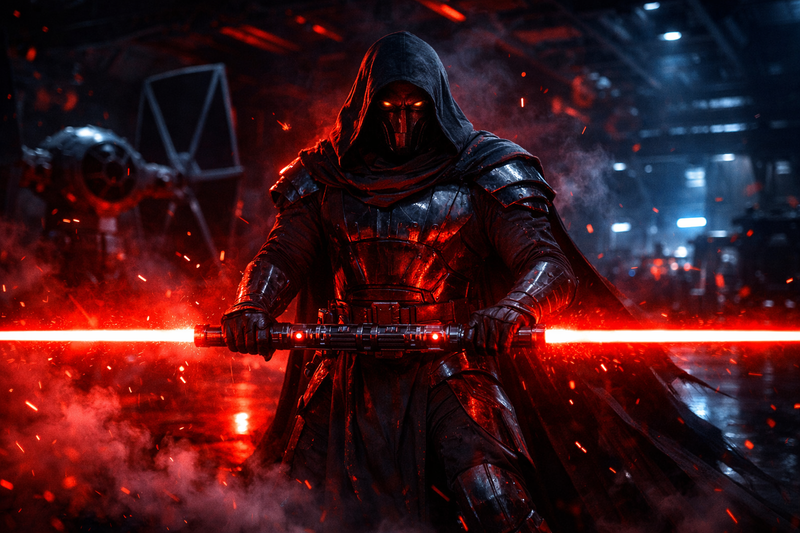
Top 10 SW Characters Who Wielded Double-Bladed Sabers
From Darth Maul to Bastila Shan — the warriors who mastered the galaxy's most feared weapon.
Read Article →