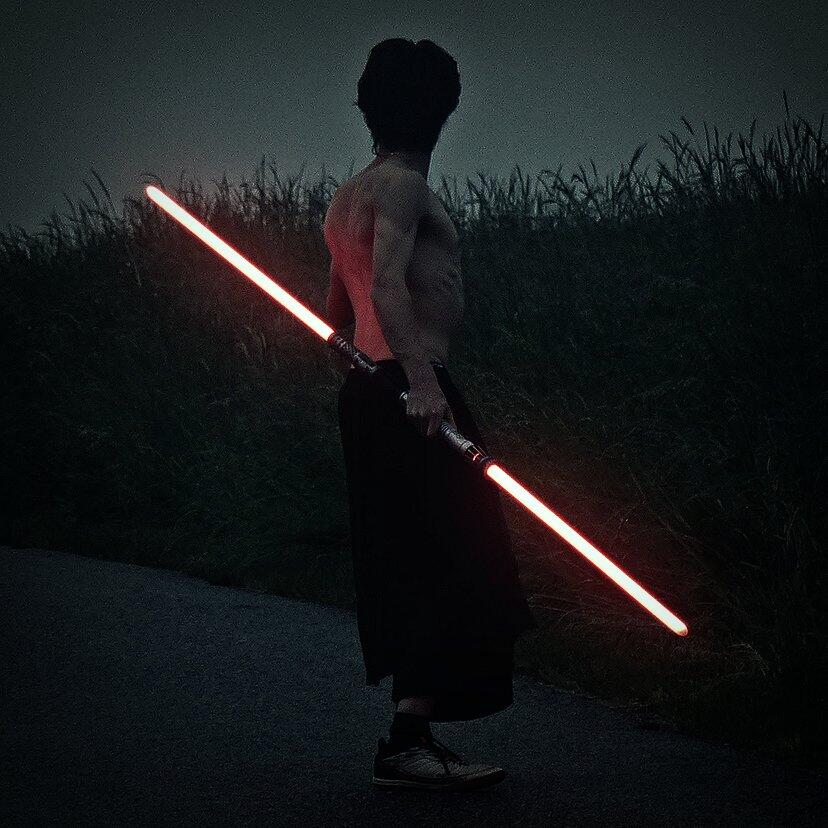
I bought the “Maul-Ventress RGB/Neopixel Saber” with the Xenopixel and weathered options, because it's exactly the Shadow Lord's lightsaber. I'll try to be as objective as possible, because I know this product has potential, especially with the new series focused on Maul.
Handling and movement quality:
basic, but it has everything you’d expect from a pixel-blade lightsaber. As for the effects, there are plenty of options. The problem is that it’s difficult to program these effects using the lightsaber’s button because you can’t see the button LED flashing, but thanks to the Bluetooth-enabled app, you can program everything more easily.
Card quality:
The internal system includes a mini SD card, which allows you to add sounds. You can also do this via Bluetooth using the app. All the necessary information is clearly explained in the included booklet. If you also have programming knowledge, you can force the SD card’s structure to reprogram it like the Proffieboard V2.2 version. But I don’t recommend it because you really need to know what you’re doing to avoid corrupting the base program.
Material quality:
There are, however, a few minor issues here. This is a collector’s sword, intended for display, not for combat. So it’s normal for it to be heavy. However, the threads in the aluminum don’t hold up well over time. I therefore recommend not unscrewing and screwing it back together too often, as you’ll damage the threaded shaft. The same goes for the small steel screws that secure the blade and the coupler; they can sometimes break if you tighten them too much, so avoid removing and reattaching them too often. If you use this double sword for artistic combat forms, you’ll also often encounter this problem: there’s some play in the screw connection that holds the two swords together. This play can damage the coupler and render it unusable over time due to the friction of the steel screws against the aluminum. These two materials are not suitable for this type of practice, but it is difficult and too costly for manufacturers to machine the handles out of steel as well, even though this solution would be of higher quality. I therefore recommend that you also purchase a snap-fit connector from another website. This type of connector does not require screws; it can simply be snapped apart, which is doubly beneficial: first, because you can separate your sword into two parts while using it, and second, because the play in this connector does not damage the lightsabers.
Sound:
You can adjust the volume and motion sensitivity (for a smoother swing effect) using the app. However, the connector also poses a problem because it blocks the sound coming from the bottom of both lightsabers, especially since you’ll need to place your hand there if you want to perform clean spins. From what I can tell from the promotional videos for the Saber 89, the sound quality is better, which I find quite possible even though I haven’t bought it. The sound of this lightsaber is already very refined and will meet your expectations, I’m sure.
A quick note on customizing effects via the app:
There are 8 different settings called “saber mode” in the app, and “blade mode” in the user manual. Developer, please read this carefully. If you configure these settings via the LED button directly on the lightsaber, you get the following settings:
- standing mode
- broken ignition
- photon ignition
- stack ignition
- wope ignition
- phaser ignition
- scavenger ignition
- hunter ignition
If you adjust the same settings from the Bluetooth app, you get these:
- standing mode
- velocity mode
- torch mode
- blaster mode
- ghost mode
- broken ignition
- photon ignition
- stack ignition
These aren't the same settings, so if you want the “torch mode” effect, you have to use the app. I think there was actually a post-design issue with this program, right before the parts were assembled at the factory (which, unfortunately, is in China). There are actually two categories of effects that are mixed up here: blade mode effects and ignition mode effects: standing mode, broken ignition, photon ignition, stack ignition, wope ignition, phaser ignition, scavenger ignition, and hunter ignition are ignition modes, while velocity mode, torch mode, blaster mode, and ghost mode are more like blade modes. These latter effects can also be likened to the app’s “hum effects.”
One final minor detail is that the track option (playing music or a line of dialogue) does not work, whether via motion control or via the app.
There you go—I hope this long review helps you make your decision, even though I didn't focus primarily on the good points of this lightsaber. You can always check out my Instagram: @gab.maul to see this lightsaber in action or to ask me any questions.